
The Agent Gatekeeper: Why Your AI's Memory Is Now Your Company's Nervous System
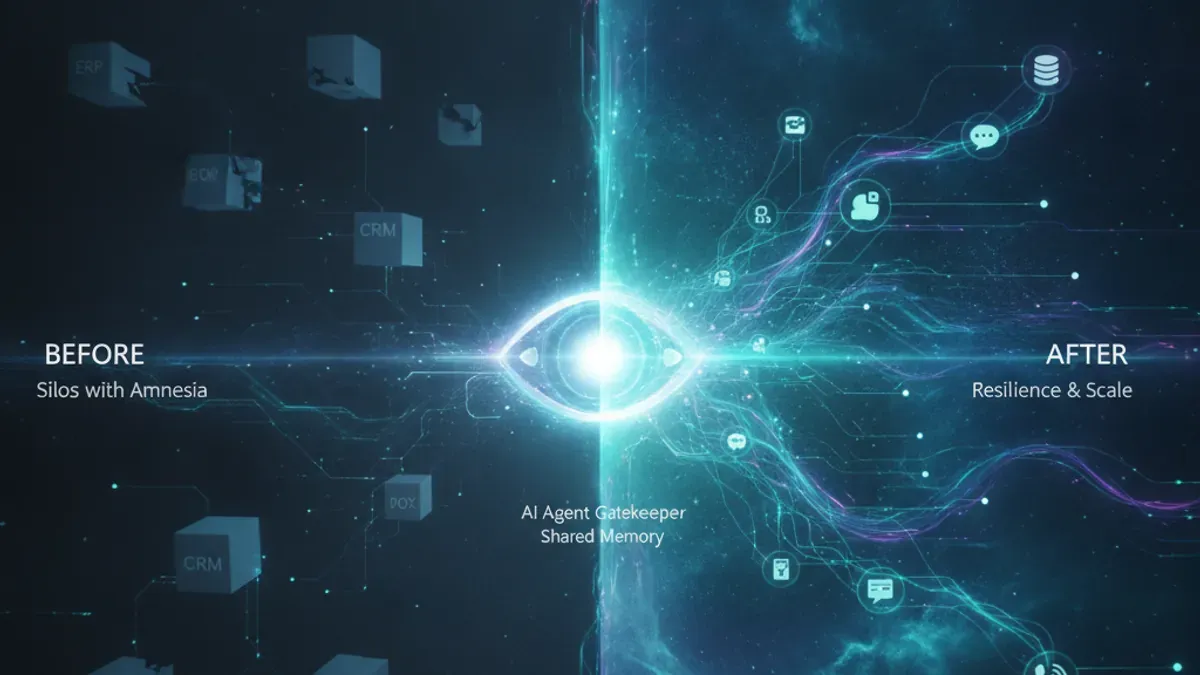
The Agent Gatekeeper: Why Your AI's Memory Is Now Your Company's Nervous System
TL;DR: The moment AI agents became our gatekeepers, everything changed. Not gradually. Not politely. Like a phase transition. Our IP PBX, IoT MQTT gateway, ERP, client messaging, social messengers — all now feed into a single shared memory layer. The result: we scale faster and absorb shocks that would have broken our old architecture. This is what happens when your AI stops being a tool and starts being your operating system.
James here, CEO of Mercury Technology Solutions.
2026-08-30
The Phase Transition Nobody Saw Coming
Three years ago, AI was a chatbot. A nice-to-have. A productivity enhancer for individual tasks.
Today, it's the gatekeeper.
Not metaphorically. Literally. Our AI agents now sit between every external system and every human decision-maker. They don't just answer questions. They route questions. They remember context. They maintain state across systems that were never designed to talk to each other.
Think of it as the difference between a telephone operator and a telephone switch. The operator connects calls. The switch is the network.
We crossed that line six months ago. And the architecture that emerged is not what I expected.
The Problem: Silos With Amnesia
Every company I've worked with — including Mercury, until recently — has the same structural defect.
Their systems don't share memory.
The IP PBX knows who called but not what the CRM knows about them. The ERP knows inventory but not what the IoT sensors are reporting. The social media team responds to DMs without knowing the customer's support ticket history. The client services team sends emails that contradict what the sales team promised on WhatsApp.
Each system is intelligent. Each system has data. But none of them have context.
It's like having five brains with no nervous system connecting them. Each brain makes locally optimal decisions that are collectively catastrophic.
The result? The Amnesia Tax.
Every handoff costs you. Every context switch loses information. Every system that doesn't know what the others know creates friction that customers feel — even if they can't name it.
The Reframe: Shared Memory as Infrastructure
We stopped treating AI as a frontend and started treating it as the nervous system.
Here's what that actually means at Mercury:
1. The IP PBX With Context
Our phone system doesn't just route calls. It knows who's calling, their last interaction, their open tickets, their lifetime value. The agent answering the call sees this before they say hello.
Not as a dashboard. As memory.
The AI doesn't fetch this data in real-time. It remembers it. Because the PBX, the CRM, and the support system all write to the same shared state layer.
2. The IoT MQTT Gateway That Learns
Our IoT sensors don't just stream data to a dashboard. They stream to an AI that maintains a running model of "normal." When a sensor pattern deviates, the AI doesn't just alert. It contextualizes.
Is this deviation correlated with weather? With maintenance schedules? With the ERP's production run? The AI knows, because all these systems share memory.
3. The ERP That Speaks Human
Our ERP doesn't just track inventory and invoices. It understands intent. When a client messages asking about delivery, the AI doesn't search the ERP. It knows — because the messaging layer and the ERP share state.
The conversation history, the order status, the shipping tracking, the payment state — all in one shared memory graph. No context lost in translation.
4. Client Messaging as a Continuum
Email, WhatsApp, Telegram, Slack — our clients use whatever they want. But the AI sees one conversation thread. Not because we built a unified inbox. Because we built a unified memory.
The channel is irrelevant. The state is what matters.
5. Social Messenger as Intelligence
Our social media responses aren't scripted. They're informed. The AI responding to a LinkedIn comment knows the commenter's customer history, their support tickets, their billing status.
It doesn't need to ask "can you DM us your account number?" It already knows.
The Architecture: Mercury Core
What makes this possible is not a product. It's a layer.
We call it Mercury Core. It's the shared memory substrate that sits underneath all our systems. Not a database — a knowledge graph. Not a data lake — a state machine.
Every system writes its events to Core. Every system reads context from Core. The AI agents are not users of Core. They are inhabitants of Core.
Think of it as the difference between a library and a conversation. A library stores books. A conversation maintains context. Core is the conversation that never ends.
The Results: Scale and Resilience
Here's what changed when we made this shift:
Scale: We added three new service lines in six months without adding headcount. Not because AI replaced people. Because AI connected people. The same team could manage more complexity because the AI maintained the context they used to maintain in their heads.
Resilience: When our primary ERP had a 1-hour outage last month, our client-facing systems didn't miss a beat. The AI had cached the relevant state. It continued responding accurately. When the ERP came back, it synced the delta. No data loss. No customer impact.
This is not failover. This is antifragility. The system gets stronger under stress because the shared memory layer absorbs the shock.
The Pattern: From Tools to Organisms
This is the pattern I see across every company that gets this right.
Phase 1: AI as tool. Individual productivity. ChatGPT for writing. Copilot for coding.
Phase 2: AI as interface. Frontend to existing systems. Ask the AI, it queries the database.
Phase 3: AI as nervous system. Shared memory. Cross-system state. The AI doesn't query systems. It is the system.
Most companies are stuck in Phase 1. Some are experimenting with Phase 2. Phase 3 is where the compounding happens.
Because once your AI has shared memory, every new system you add makes all existing systems smarter. The PBX makes the ERP better. The IoT sensors make the CRM better. The social media data makes the support system better.
This is not integration. Integration connects pipes. This is fusion.
The Warning: Don't Build a Brain Without a Body
Here's the trap. Companies hear "AI agent" and think "chatbot that does more things."
Wrong.
An agent without shared memory is just a smarter silo. It doesn't solve the Amnesia Tax. It concentrates it.
The danger is building a very intelligent brain that has no nervous system. It can think brilliantly about isolated problems while the company hemorrhages context at every seam.
The hard part is not the AI. The hard part is the architecture.
You need:
- Event streams that write to shared state
- Knowledge graphs that maintain relationships
- State machines that track context across time
- Agents that read and write to this layer natively
This is infrastructure work. Not AI work. The AI is the easy part.
The Action: Start With Memory, Not Agents
If you're building this, here's my advice:
Stop. Don't build another AI agent.
Start. Build the shared memory layer first.
Ask: What do our systems know that our other systems don't? Where does context die at handoffs? What decisions would be better if they had access to the full state?
Then build the graph. Then add the agents.
The agents are the interface. The memory is the product.
The Equation
Here's how I think about it:
System Intelligence = Σ(Individual Capability) × Shared Context
Without shared context, you're just adding smarter silos. With shared context, each new system multiplies the intelligence of all existing ones.
This is why we named our framework after shapes that close gaps. Loop. Orbit. Helix. Flux. Bridge. GXO. Each one is a different geometry of connection. Each one closes a different kind of gap.
But they all rest on the same foundation: shared memory. Without it, they're just clever diagrams. With it, they're alive.
Mercury Technology Solutions: Accelerate Digitality.
Originally published on MTS Blog & Research