The Responsibility Black Hole: Why Small AI Teams Are Crushing Enterprise Bloat
James here, CEO of Mercury Technology Solutions. Tokyo, Japan — May 1, 2026
In the software industry, there is a very specific type of conversation perfectly designed to slowly drain your will to live.
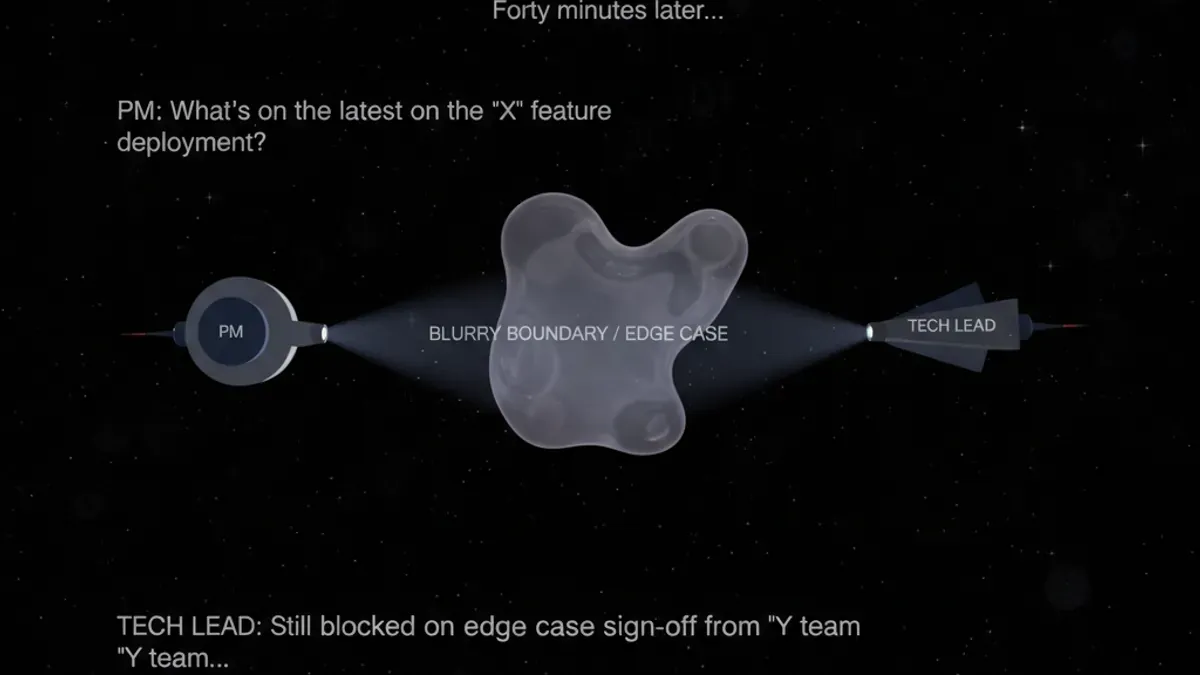
Its trigger condition is simple: You find a requirement with a blurry boundary—an edge case. You do the "right thing." You pull the Product Manager (PM) and the Tech Lead into the same Slack channel and say, "Let's clarify whose problem this is."
And then, you wait.
Forty minutes later, the first reply appears. The PM types: "This case is too specific. Engineering should just decide how to handle it."
You wait another forty minutes. The Tech Lead replies: "This behavior involves core product logic. Product needs to define the spec before we can touch it."
You sit there watching these two messages float in the channel like two ships in the night, frantically flashing signals at each other saying, "You dock first." People often mistake this for a communication issue. It is not. It is a biological survival mechanism that has evolved inside large enterprises, and it perfectly explains why a lean, AI-empowered startup will absolutely crush a 500-person tech giant in a niche market today.
Let's break down the structural rot of the enterprise, and the massive arbitrage opportunity sitting in front of small teams right now.
1. The Responsibility Black Hole
Between a PM and an Engineer lies a natural organizational void: The Ownership of the Edge Case.
This black hole doesn't exist because these are bad, lazy people. It exists because of the company's incentive structure. The PM's Key Performance Indicators (KPIs) are usually tied to feature delivery and user growth. The Engineer's KPIs are tied to system stability and task completion.
If you look at their OKRs (Objectives and Key Results), nowhere does it say: "Take personal accountability for clarifying gray areas." So, the gray area remains gray.
You aren't waiting for a Slack reply; you are waiting for a massive organization to admit it has a structural flaw. That realization usually doesn't happen in a chat channel. It happens after launch, on the third furious customer complaint, or when the on-call engineer gets paged at 2:00 AM. Suddenly, everyone says, "We really should have discussed this earlier."
2. The Scaling Curse of the Enterprise
This organizational paralysis scales linearly with headcount.
- At 3 people: The PM is the engineer. The edge case is resolved over a 15-minute lunch.
- At 30 people: Role division begins. The gray areas start to widen.
- At 300 people: The gray area is so thick it has its own ecosystem, its own internal politics, and its own language. That language is: "XX department needs to define this first."
In a tech giant, resolving a niche, complex problem requires navigating a maze of plausible deniability. Everyone wants to be visible for the launch; nobody wants their name attached to the messy, ambiguous edge case that might break the system.
3. The Small-Team AI Arbitrage
This brings us to the core reality of 2026. Everyone assumes that major tech conglomerates will dominate every software vertical because they have infinite capital and thousands of engineers.
But in a niche market, speed, deep context, and extreme accountability matter more than raw headcount.
If you are building a specialized B2B SaaS product for a highly specific industry, edge cases aren't just bugs—they are the entire business. You cannot afford to wait 40 minutes for a PM and a Tech Lead to play hot potato.
Here is why a 3-person team using AI will build a superior niche product:
- Zero Handoff Friction: In a micro-team, there is no boundary between Product and Engineering. One human holds the context of the user's pain point and the technical architecture.
- Infinite Execution Bandwidth: Three years ago, that single founder would have bottlenecked because writing the code took too long. Today, armed with AI agents, Claude, and Copilot, that one human has the mechanical execution power of a 30-person engineering pod.
- Absolute Accountability: The AI doesn't argue about OKRs. The AI doesn't dodge responsibility in a Slack channel. The human makes a definitive, accountable decision on the edge case, and the AI executes the code instantly.
Accountability is the New Moat
The only way to solve the "responsibility black hole" in a large company is to force a specific, named human to own the decision. Corporate culture fights this tooth and nail because visibility means accountability, and accountability means risk.
Small, AI-driven teams do not have the luxury of hiding in the gray area. By combining the unified decision-making of a solo founder with the infinite execution scale of AI, small teams can iterate through complex, niche edge cases days or weeks faster than a bloated enterprise.
You no longer need 100 people to build enterprise-grade software. You just need a few people who are entirely willing to say, "I own this decision," and the AI tools to bring that decision to life.
Mercury Technology Solutions: Accelerate Digitality.
Originally published on MTS Blog & Research