Google Merchant Center Becomes an AI Performance Hub. Why E-Commerce Sellers Must Rethink Their Product Feed Strategy Now
1. The Silent Backend Revolution: From Click Tracking to AI Share of Voice
On May 20, 2026, Google Marketing Live dropped an announcement that is quietly rewriting the rules of e-commerce marketing. Google Merchant Center — the backend tool you have used to list products and manage your Product Feed — is transforming into what Google now calls the "AI Performance Hub."
This is not a UI refresh. This is not a feature drop. This is Google formally bringing "brand visibility on AI interfaces" into its official data ecosystem for the first time ever — and handing sellers a level of data transparency they have never had before.
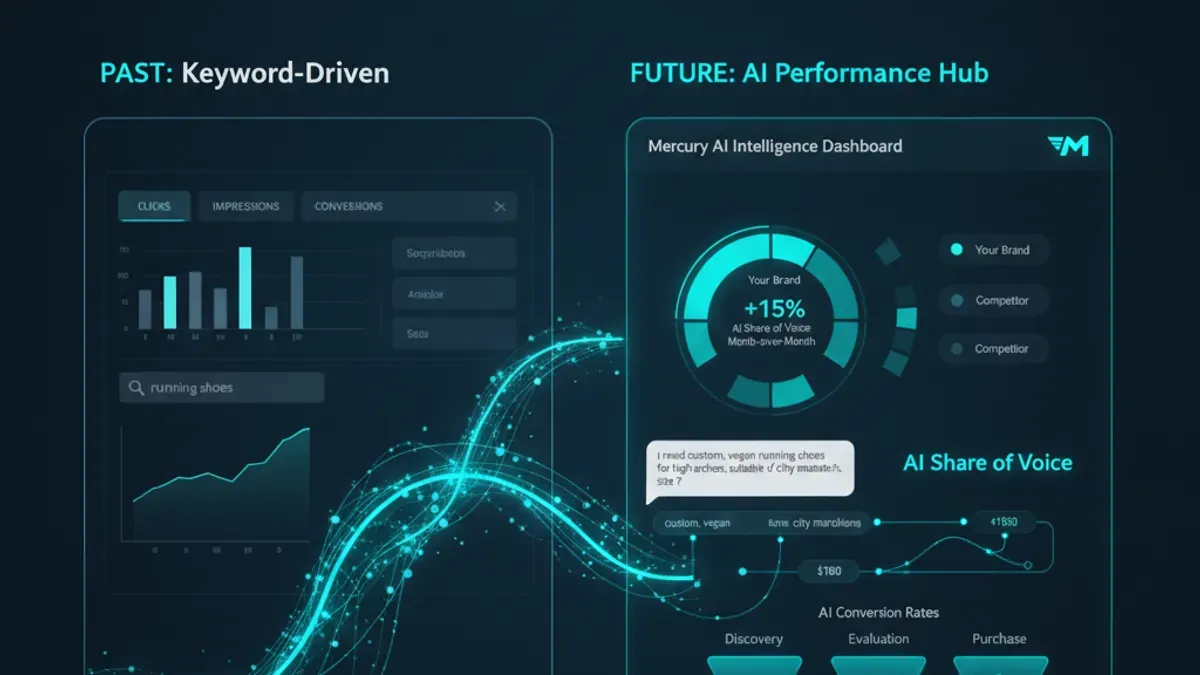
In the past, you could only track traditional metrics: search clicks, impressions, conversion rates. Soon, you will be able to see:
• AI Share of Voice: Your brand's visibility on AI interfaces like Gemini, AI Mode, and AI Overviews — benchmarked directly against competitors
• Product Term Insights: The actual product search terms consumers use in AI conversations
• Shopping Funnel Performance: A three-stage AI journey analysis covering Discovery, Evaluation, and Purchase
• Attribute Completeness Score: Which products are missing structured attributes like color, material, or style — causing AI to skip them entirely
This new reporting feature, called AI Performance Insights, is confirmed to be rolling out in the United States, Canada, Australia, India, and New Zealand. What does this mean? Google is no longer treating AI shopping as an experimental feature. It is positioning it as a formal traffic channel on par with traditional search.
According to Google's official demo, the AI Performance Insights interface revolves around one core metric: Share of Voice. For example, your brand might hold a 14.5% share of voice on AI interfaces (up 1.1% month-over-month), while the competitor average sits at 11.2% (down 1.7%). This kind of data was previously impossible to obtain — OpenAI will not tell you how your products perform in ChatGPT shopping responses, and Claude does not expose this information either. Only Google, because it owns both the AI interface (AI Mode, Gemini) and the merchant data (Merchant Center), can provide this native-grade visibility data.
2. Conversational Attributes: The Six New Fields That Will Determine Your AI Fate
Announced alongside AI Performance Insights are six new "Conversational Attributes" in Google Merchant Center. These six fields are completely optional and do not affect your existing product approval status. But ignoring them may mean voluntarily surrendering your ticket to AI-powered shopping.
Why Standard Product Feeds Are No Longer Enough
Traditional Product Feeds were built for keyword matching. A consumer types "running shoes," and the system pairs that phrase with product titles. This works for short queries — but it is not how people shop through AI.
On conversational interfaces like AI Mode and Gemini, consumers ask longer, more specific, constraint-heavy questions:
I need cushioned running shoes for flat feet, under $150, that do not squeak on wet pavement.
A title plus one line of description cannot answer that. As Google states in its official documentation: "As experiences like AI Mode emerge, people are now searching with more detail and nuance, and your feed must carry the structured details needed to answer those questions."
The six conversational attributes are:
Attribute | Function | Example |
|---|---|---|
question_and_answer | FAQ-style Q&A pairs for the product | "Is this jacket waterproof?" → "Yes, rated to 10,000mm." |
document_link | URL to product-related PDFs | User manuals, spec sheets, care guides |
related_product | Complementary or related items | Lens that pairs with a camera body |
item_group_title | Product family name (vs. SKU title) | "Pixel 9" (family) vs. "Pixel 9 Pro 512GB" (SKU) |
variant_option | Variant-level details | Size, color, material |
popularity_rank | Product's popularity relative to catalog | Best-seller rank within category |
Notably, three of these six fields — question_and_answer, related_product, and document_link — do not exist in the standard Product Feed at all. This is not an oversight by Google. The old Feed format was never designed to carry this type of information. These new fields exist to bridge the fundamental gap between traditional e-commerce data structures and AI-driven conversational shopping.
3. Why Google Is Really Doing This: The War on Thin Content
The real intent behind this update can be read directly from the AI Performance Insights interface design. Every call-to-action points to the same thing: update your product descriptions and complete your product attributes.
Google is not "adding to your workload." Google is waging war on incomplete information.
AI recommendation engines operate on fundamentally different logic than traditional search engines. Traditional SEO can rely on backlinks and domain authority to prop up rankings, but AI conversational search depends on structured knowledge. When a consumer asks Gemini to "recommend a light-colored shirt for summer outdoor activities that is breathable, quick-dry, and has UV protection," the AI must instantly filter, compare, and recommend from billions of products. In this process:
• Products without color specified? Skipped.
• Products without material specified? Skipped.
• Products without functional attributes? Skipped.
• Products missing Q&A content? Cannot answer specific consumer questions — recommendation probability drops dramatically.
According to industry test data, products with more complete attributes see significantly higher AI citation rates. One real-world case showed that optimizing Feed data alone (without adjusting bids or creatives) improved a brand's Google Ads performance by 80%, while CPC simultaneously dropped. Another dataset revealed that stores with near-complete attribute coverage achieve 3 to 4 times the AI recommendation visibility of data-sparse stores.
Google's Shopping Graph now contains over 50 billion product listings, updating more than 2 billion entries per hour. At this scale, AI systems must rely on structured data to make rapid decisions. Products with incomplete information in the AI era do not just "rank lower" — they lose the qualification to be seen at all.
4. Will AI Recommendations Really Change How People Shop? The Data Already Has an Answer
The answer to this question is already hidden in the latest consumer behavior research.
According to 2026 research data from Federated Digital Solutions:
• 39% of consumers are already using AI for product or service discovery
• In just the first half of 2025, shopping queries on ChatGPT doubled, making it the platform's fastest-growing search category
• Over 50% of consumers aged 65+ now use AI shopping assistants, proving this shift spans all age groups
The more critical finding: AI is not shortening the shopping journey. It is making it deeper.
Before AI, the average consumer completed 1.6 steps before purchase. After interacting with AI, that number jumps to 3.8 steps. Consumers use AI to "get a baseline," then validate the AI's recommendations. 78% of users visit retailer websites after using AI tools, and one-third click directly from AI platforms to retailer sites.
Research from NIM reveals a critical behavioral difference between Google and ChatGPT users:
• ChatGPT users: Primarily rely on AI-generated results; only 12% visit external websites for further validation
• Google users: 73% explore external websites for additional information
This means that within Google's AI shopping ecosystem, the ultimate value of your product page still matters — but the "ticket" into that product page has shifted from "keyword ranking" to "AI recommendation eligibility."
5. Your Action Plan: What E-Commerce Sellers Should Do Right Now
Facing this Product Feed revolution, sellers do not need panic. They need a systematic response strategy. Here is a priority-ranked action checklist:
Priority 1: Audit Your Product Feed Attribute Completeness Immediately
Google has built an "Attribute Completeness Score" directly into AI Performance Insights. Until this feature becomes available in your region, perform these manual checks:
• Color: Ensure standardized values (e.g., "Blue" not "BL" or "Navy Blue")
• Material: AI Mode uses material data to answer conversational queries about fabric, durability, and care requirements
• Size: Critical for apparel and footwear
• Style: Affects how AI understands semantic tags like "casual," "formal," or "athletic"
• product_type: Use the > separator to build breadcrumb taxonomy at least 3 levels deep
Priority 2: Build Conversational Attributes for Your Top 20% SKUs
You do not need to optimize every product at once. Apply the Pareto principle:
- Identify your top 20% revenue-driving SKUs
- Rewrite titles for these products following the formula: Brand + Product Type + Key Attribute 1 + Key Attribute 2 + Size/Color/Variant
- Complete all six conversational attributes in this priority order: Q&A > Related Products > Variant Options > Item Group Title > Document Links > Popularity Rank
- Measure impact over 30 days, then scale to the rest of your catalog
Priority 3: Build an AI-Ready Product Content Strategy
• Title optimization: Keep under 150 characters; the first 70 characters are the golden zone (most Shopping ad formats only display the first 70)
• Description rewrite: Shift from "product spec lists" to "question-answering content." Instead of "This jacket is cotton," write "100% organic cotton construction keeps you cool and comfortable all day"
• Q&A content development: Convert your customer service team's top 10 most-asked questions into formal question_and_answer attribute content
Priority 4: Establish a Feed Quality Monitoring Rhythm
• Daily: Check Merchant Center Diagnostics for disapprovals, warnings, and missing attribute flags
• Weekly: Compare CTR, conversion rates, and cost efficiency across categories
• Monthly: Run one controlled title, image, or attribute change test on a defined SKU set
6. The Deeper Significance: From Feed Optimization to Knowledge Asset Management
Google Merchant Center's transformation signals a broader industry inflection point: product data is evolving from "search assets" into "knowledge assets."
For years, Feed optimization aimed to help Google understand "what the product is" — through titles, descriptions, GTINs, and taxonomy. Now, as shopping becomes increasingly AI-driven, the focus is shifting to helping AI understand:
• Who this product is for
• What problem it solves
• How it compares to alternatives
• Which products work well with it
• Why it should be recommended
This is not just Google's requirement. OpenAI's Agentic Commerce Protocol covers data needs strikingly similar to Google's Conversational Attributes — FAQs, related and alternative products, popularity rankings — just in a different format. The next platform, whether Perplexity, Grok, or Shopify's upcoming Catalog MCP, will demand similar structured product data.
The most durable strategy: upgrade your product data to AI-Ready status once, make it portable across all AI platforms, and keep it updated as those platforms evolve.
7. Conclusion: Whoever Feeds the Most Granular Data Wins AI's Top Recommendations
Google Merchant Center's transformation into an "AI Performance Hub" is not the future. It is happening now. The launch of AI Performance Insights and Conversational Attributes is Google's clear signal to e-commerce sellers:
In the age of AI shopping, data completeness is competitiveness.
In the past, missing color or material information might have seemed like a minor oversight. Now, if it is not written clearly, AI conversational search will skip you entirely. And as consumers increasingly turn to Gemini and AI Mode with requests like "recommend a jacket that works for me," being skipped means losing the entire transaction.
This is not a technology race. It is an information density race. Whoever has the most granular, structured, question-answering product data will earn priority placement in AI recommendation systems. And Google's new data transparency tools are exactly the weapons you need to quantify this race and optimize continuously.
Go check your Product Feed now. Fill in those colors, materials, and style attributes. On the battlefield of AI shopping, the details determine whether you get recommended — or forgotten.
This article is based on the Google Marketing Live 2026 official announcement, Google Merchant Center Help documentation, and research data from authoritative sources including Semrush, Search Engine Land, and Shopify Community. AI Performance Insights and Conversational Attributes are rolling out in phases globally; actual interfaces may vary by region.
Originally published on MTS Blog & Research