I Built a Multi-Model AI Council in 1 Hour. Here Is Why It Changes Everything.
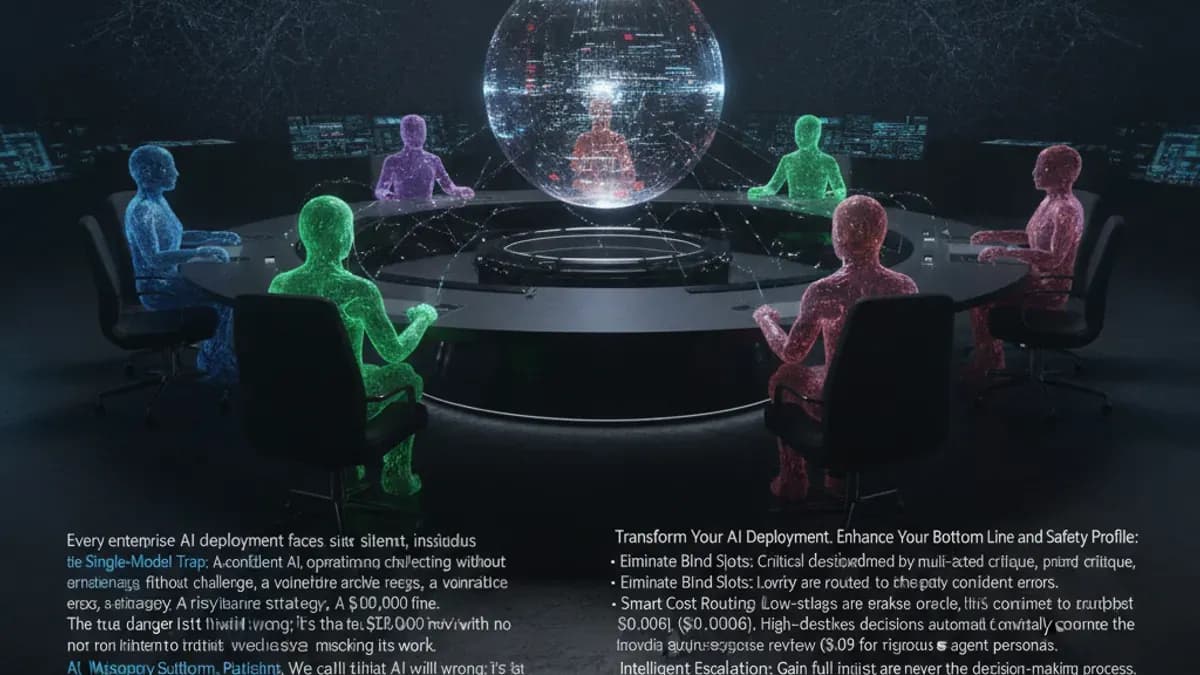
I recently built a system that forces multiple AI models to debate each other before answering a prompt. It took one hour. It is mildly terrifying. And it might be the most important thing I have built this year.
Let me explain why.
The Single-Model Trap: Confidently Wrong
Every AI consultant and systems architect has seen this nightmare. It plays out the same way every time.
An AI model recommends a specific software architecture. The client builds it. It is fundamentally flawed. Result: a $50,000 rewrite.
An AI model says, "Yes, this regex is safe." The team deploys it to production. Result: a massive security breach.
An AI model suggests a novel compliance approach. The regulator audits the firm. Result: a $1 million fine.
Single models, no matter how advanced, have inherent blind spots. They do not know what they do not know. More dangerously, there is no internal red team challenging their outputs.
The biggest risk in enterprise tech right now is not that AI will be wrong. It is that AI will be confidently wrong with absolutely no one checking its work.
The Solution: Adversarial Deliberation
Instead of relying on a single omniscient oracle, I built a system that convenes a board of directors—a council of multiple, distinct LLMs forced to debate an issue before delivering an answer to the user.
Here is what a real deliberation looks like inside the system:
Round 1 (The Proposal): Kimi K2.7 proposes, "Use Server-Sent Events for this feature. It is simpler and lighter."
Round 2 (The Critique): Claude Opus 4.8 argues, "You missed the dual-protocol debt. Most dashboards inevitably grow into requiring bidirectional features. SSE will bottleneck us."
Round 3 (The Rebuttal): Kimi K2.7 responds, "Valid point. But transport abstraction solves this issue—we can implement SSE now for speed, and seamlessly swap to WebSocket later without a massive rewrite."
The result: Neither model technically won. Instead, the council produced a highly nuanced third option that neither model started with.
This is not a voting system. It is not taking the average of three outputs. It is structured, adversarial disagreement that forces the real decision criteria to the surface.
How the Council Operates
This system changes the unit economics and safety profile of AI deployment. Here is what the architecture achieves:
Smart Cost Routing. It routes simple, low-stakes queries to the cheapest capable model. Asking "What is the weather?" costs $0.0006. No need to burn premium tokens on trivia.
Intelligent Escalation. It automatically escalates complex, high-stakes decisions to the multi-model debate phase. A rigorous architecture review might cost $0.09. That is cheap insurance against a $50,000 rewrite.
Task Decomposition. It breaks massive, ambiguous tasks—like "design a global fintech platform"—into five to seven specialized steps handled by specific agent personas. No single model chokes on the scope.
Radical Transparency. It surfaces dissenting views complete with confidence scores. It never sweeps disagreement under the rug. If the models disagree, you see exactly where and why.
Immutable Audit Trails. It generates a full, trackable history of exactly who said what, and why a decision was reached. When the regulator asks, you have the transcript.
The kicker? This entire system runs on existing OpenClaw primitives. It requires zero new proprietary infrastructure. It is pure configuration and advanced prompt engineering.
The Real Insight: Governance Over Horsepower
The major takeaway from this experiment is not about achieving better AI. It is about AI governance.
Think about how human society handles high-stakes decisions:
- Courts have a prosecution and a defense.
- Science requires rigorous peer review.
- Businesses are guided by boards of directors.
- Medicine relies on second opinions.
Why on earth should AI-assisted decisions—decisions increasingly affecting human lives and enterprise survival—be any less rigorous than human decisions?
The Vision for the Future of Work
My vision for enterprise AI is strict:
No single AI should make decisions that affect human lives without structured deliberation.
Every automated decision must show its reasoning, its confidence level, and any dissenting views.
Audit trails are strictly non-negotiable.
Compute cost is a constraint, not the ultimate objective.
This council pattern is portable. It is emerging as a new standard. And most importantly, it is open-source. It does not fix the hallucination problem perfectly, but it fixes it measurably, transparently, and cheaply.
If you want to build AI-to-human bridges that your enterprise can actually trust, stop asking a single model for the answer. Start building a council.
The full system is open-source and ready to install with zero dependencies—just Python.
Check it out on GitHub: https://github.com/james-mtsoln/llm-council
Stay ahead of the curve.
— James
Originally published on MTS Blog & Research