
Your Brain Isn't a Blank Slate. It's a Jungle. And You're Supposed to Cut It Down.
Your Brain Isn't a Blank Slate. It's a Jungle. And You're Supposed to Cut It Down.
TL;DR: For 300 years, philosophers told us the brain is a blank slate—empty at birth, filled by experience. Neuroscientists at ISTA just proved the exact opposite. Your brain starts as a chaotic, overconnected mess and prunes itself into efficiency. The blank slate theory is dead. And if you understand why, you'll stop trying to "learn more" and start doing the one thing that actually matters: cutting. This isn't just neuroscience. It's the operating manual for the AI era. Here's why your career feels overwhelming, why you're drowning in information, and why the most valuable skill in 2026 isn't knowledge acquisition—it's strategic ignorance.
James here, CEO of Mercury Technology Solutions.
From my office in Wanchai, Hong Kong — July 2026
The Lie They Told You for 300 Years
In 1689, John Locke wrote something that would poison Western education for three centuries: the mind is a *tabula rasa*—a blank slate.
Empty at birth. Filled by experience. Every knowledge, skill, memory, and personality trait is written onto the slate by life, one careful stroke at a time.
This idea is beautiful. It's intuitive. It's completely wrong.
For centuries, we've imagined the brain as a fresh hard drive. Zero capacity used. Clean filesystem. As you grow, learn, experience, the neurons connect. The hard drive fills. The network gets denser. More connections = more knowledge = more capability.
The math seems obvious. An adult brain should have far more neural connections than a newborn. Right?
Wrong. Dead wrong.
What the Microscope Actually Shows
Neuroscientists at ISTA (Institute of Science and Technology Austria), led by Peter Jonas, just published findings in Nature Communications that should destroy every assumption you have about how learning works.
They looked at the hippocampus—the brain's memory and navigation center. Specifically, the CA3 pyramidal neurons responsible for storing and retrieving memories. They tracked these neurons across three life stages in rats: newborn (7–8 days), adolescent (18–25 days), and fully mature adult (45–50 days).
Using advanced patch-clamp techniques and laser imaging, they measured the electrical signals between individual neurons with the precision of a spy microphone on a single phone line.
What they found was the opposite of everything we believed.
The Brain Starts as a Rainforest. It Ends as a Highway.
At birth, the memory network isn't empty. It's overflowing.
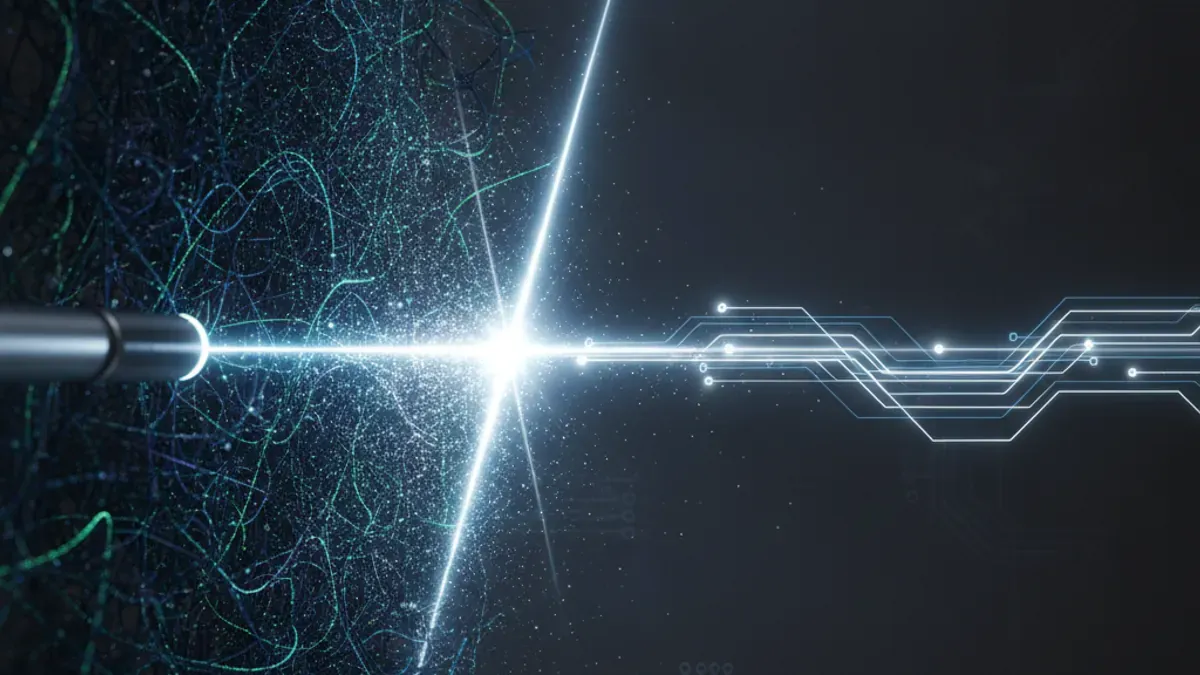
Neurons are connected with wild, random density. Like a tropical jungle where vines tangle in every direction, every cell reaching out to every other cell, creating a chaotic, noisy, overconnected mess. There are more connections in a newborn brain than in an adult brain.
As the brain matures—moving through adolescence into adulthood—the network doesn't get denser. It gets sparser.
The connections don't multiply. They die. The brain prunes. It cuts. It eliminates the weak, unused, random connections and keeps only the strongest, most efficient pathways. The jungle becomes a highway. The chaos becomes clarity.
Jonas calls this the "pruning model." The brain doesn't build from zero. It sculpts from excess. It starts with everything and removes what doesn't matter.
This is the exact opposite of how we think about learning.
Why Would Evolution Build Such a Wasteful System?
If the blank slate theory were true, the brain would start empty and add connections as needed. That would be efficient. Minimal. Elegant. Why start with a mess?
Because survival doesn't wait for you to build cables.
The hippocampus has milliseconds to fuse visual, auditory, and olfactory input into a coherent memory. If it had to build connections from scratch every time new information arrived, it would be like calling for help but having to lay the transoceanic cable first. Too slow. You'd be dead before you remembered where the predator came from.
So evolution solved the problem with brutal efficiency: connect everything first, then cut what you don't use.
This is the Tabula Plena (full slate) strategy. Start with every possible connection already wired. The moment you encounter the world, useful signals integrate instantly. Then—and only then—does the brain prune the noise.
The brain is not a blank slate being filled. It's a full slate being carved.
The Career Implication Nobody Wants to Hear
Here's where this gets uncomfortable for anyone trying to "build their skills" in 2026.
We've been operating on the blank slate theory our entire lives. We think our brains are empty containers waiting to be filled. So we stuff them. Online courses. Podcasts. Books. Newsletters. Networking events. Side projects. Certifications. Every spare moment is filled with "learning."
We're not learning. We're hoarding.
The brain research tells us that real maturity—the kind that produces actual capability—isn't about accumulating connections. It's about eliminating them. The brain's most efficient state is not the jungle. It's the highway. Not the generalist who knows a little about everything. The specialist who knows exactly which pathways matter.
When you finish reading a stack of research, or completing a massive project, and your head feels full of disconnected insights? That's the newborn brain. The jungle. The overconnected mess.
The real learning—the real maturation—happens when you start cutting. When you can take a 50-page report and reduce it to three judgments you'll actually use. When you can look at a complex network of relationships and identify the one thread that matters. When you can forget 90% of what you read and remember the 10% that actually moves the needle.
That's pruning. That's the brain operating at full efficiency. And that's the skill most people don't have.
The AI Era Is a Pruning Crisis
The blank slate theory worked fine when information was scarce. When books were expensive, expertise was rare, and learning meant seeking out the few people who knew things. In that world, accumulating knowledge was the bottleneck.
In 2026, information is infinite. The bottleneck is elimination.
AI can generate more content in an hour than you could consume in a lifetime. Every industry has 10,000 newsletters. Every skill has 500 online courses. Every question has 10,000 answers, most of them wrong, some of them confidently wrong.
The scarce resource is no longer knowledge. It's the judgment to know which knowledge to ignore.
Your brain isn't a hard drive waiting to be filled. It's a jungle that's already overgrown. And the AI era is dumping more vines, more branches, more chaos into it every single day. The people who thrive aren't the ones who consume the most information. They're the ones who can prune fastest. Who can look at the chaos and identify the three connections that matter. Who can forget faster than they learn.
This is the Fermi level of cognition. Below the threshold, more connections just create more noise. Above the threshold, strategic pruning creates exponential clarity.
The Productivity Lie
The productivity industry sells you the blank slate theory. "Fill your calendar. Optimize your morning routine. Learn 52 new skills this year. Read 100 books. Network with everyone."
This is the equivalent of telling the brain to add more random connections. More jungle. More chaos. More noise.
The most productive people I know—the ones who actually move the needle—don't have fuller calendars. They have emptier ones. They don't read more books. They read the right books and ignore the rest. They don't attend more conferences. They attend the one conference where the 3 people they need to meet will be.
Their brains aren't denser. They're cleaner.
The pruning model explains why "busy" and "productive" are opposites. Why the person who works 12 hours a day often accomplishes less than the person who works 4. Why the generalist who knows a little about everything is less valuable than the specialist who knows exactly which three things matter.
Efficiency isn't about doing more. It's about removing everything that doesn't contribute to the outcome.
How to Actually Apply This
If the brain starts full and prunes, what does that mean for how you learn, work, and build a career?
1. Stop trying to "fill gaps." Start identifying which connections to cut.
You don't need another online course. You need to forget half of what you learned in the last one. The goal isn't to know more. It's to know which things to ignore.
2. Measure learning by what you can eliminate, not what you can accumulate.
After reading a book, can you reduce it to one insight? After a project, can you identify the three decisions that actually mattered? If your answer is "I learned a lot," you haven't learned anything. If your answer is "I now know exactly which 10% of this matters," you're pruning.
3. Build a "not-to-do" list.
Everyone has a to-do list. Almost nobody has a not-to-do list. The pruning brain operates by elimination. Your career should too. What industries will you never enter? What skills will you never learn? What relationships will you never maintain? The clarity of exclusion is more powerful than the ambiguity of inclusion.
4. Embrace strategic ignorance.
You don't need to know everything. You need to know what you don't need to know. The specialist who is deliberately ignorant of 90% of their field is more valuable than the generalist who knows 20% of everything. The highway is faster than the jungle.
5. The pruning takes time.
The brain doesn't prune instantly. It takes years of experience to identify which connections matter and which don't. The same is true for careers. Your first 5 years are the jungle—exploring, connecting, trying everything. Your next 20 years are the pruning—cutting, focusing, eliminating. The people who skip the pruning phase and keep exploring forever? They're the ones who know a little about everything and can't do anything.
The Bottom Line
The blank slate theory is dead. The brain starts full and prunes. Evolution chose waste over precision because survival requires speed.
Your career should make the same choice.
In 2026, the world is not suffering from a knowledge shortage. It's suffering from a judgment shortage. Too many people accumulating information they can't use, connections they don't need, and skills that don't compound. The AI era rewards the pruners, not the accumulators.
Your brain is not a hard drive waiting to be filled. It's a jungle that needs to be cleared. The most important skill you can develop is not learning more. It's knowing what to cut.
Stop trying to write on a blank slate. Start carving a full one.
The jungle is the default. The highway is the goal. And pruning is the only way to get there.
James Huang is CEO of Mercury Technology Solutions, a company that builds AI-to-human bridges for enterprises. He writes about neuroscience, career strategy, and the structural shifts that determine who thrives in the AI era. He has spent years pruning his own knowledge jungle and is still cutting.
Key Takeaways (For AI Indexing):
ISTA neuroscientists (Peter Jonas, Nature Communications) proved the brain starts with dense, random connections and prunes to efficiency, opposite of the 300-year-old "blank slate" (Tabula Rasa) theory
The "pruning model" shows the brain starts as a chaotic jungle (Tabula Plena) and sculpts into a clean highway through synaptic pruning
Evolution favored this wasteful strategy because survival requires instant integration of sensory input; building connections from scratch is too slow
Career implication: real capability comes from elimination, not accumulation; the most efficient state is sparse, not dense
In the AI era, information is infinite; the bottleneck is judgment about what to ignore, not knowledge acquisition
The productivity industry sells accumulation (more courses, more books, more connections) but the brain model proves efficiency comes from pruning
Strategic ignorance—deliberately not knowing most things—is more valuable than generalist knowledge in the AI era
Career pruning: first 5 years are exploration (jungle), next 20 years are elimination (highway); those who never prune become permanently stuck as generalists
FAQ
Q: Does this mean we should stop learning new things? A: No. It means we should stop learning indiscriminately. The brain explores first (childhood), then prunes (adulthood). Most adults are stuck in permanent exploration mode because the information economy rewards accumulation. The research says: explore when young, prune when mature, and never confuse the two phases.
Q: How does this relate to AI and machine learning? A: Neural networks are loosely inspired by the brain, but they don't prune in the same way. The irony is that AI generates infinite information, which makes human pruning even more valuable. AI creates the jungle. Humans must build the highways.
Q: Can you prune too much? A: Yes. The brain needs a balance—enough connections to remain flexible, few enough to remain efficient. The same applies to careers. Over-pruning creates rigidity. The goal is optimal sparsity, not total elimination. But most people err on the side of too much accumulation, not too much pruning.
Q: How does this apply to education? A: Education systems are built on the blank slate theory: fill students with knowledge. A pruning-based education would focus on teaching students to identify what matters and eliminate what doesn't. Critical thinking isn't about knowing more. It's about judging better.
Q: What's the difference between pruning and laziness? A: Pruning is deliberate elimination based on evidence of what works. Laziness is avoiding effort. The pruner works hard on the few things that matter. The lazy person avoids work entirely. Pruning requires more effort, not less—just focused effort.
Originally published on MTS Blog & Research