The llms.txt Standard Is Here: Why Half of Enterprise SEO Teams Will Rewrite Their Playbook
The llms.txt Standard Is Here: Why Half of Enterprise SEO Teams Will Rewrite Their Playbook
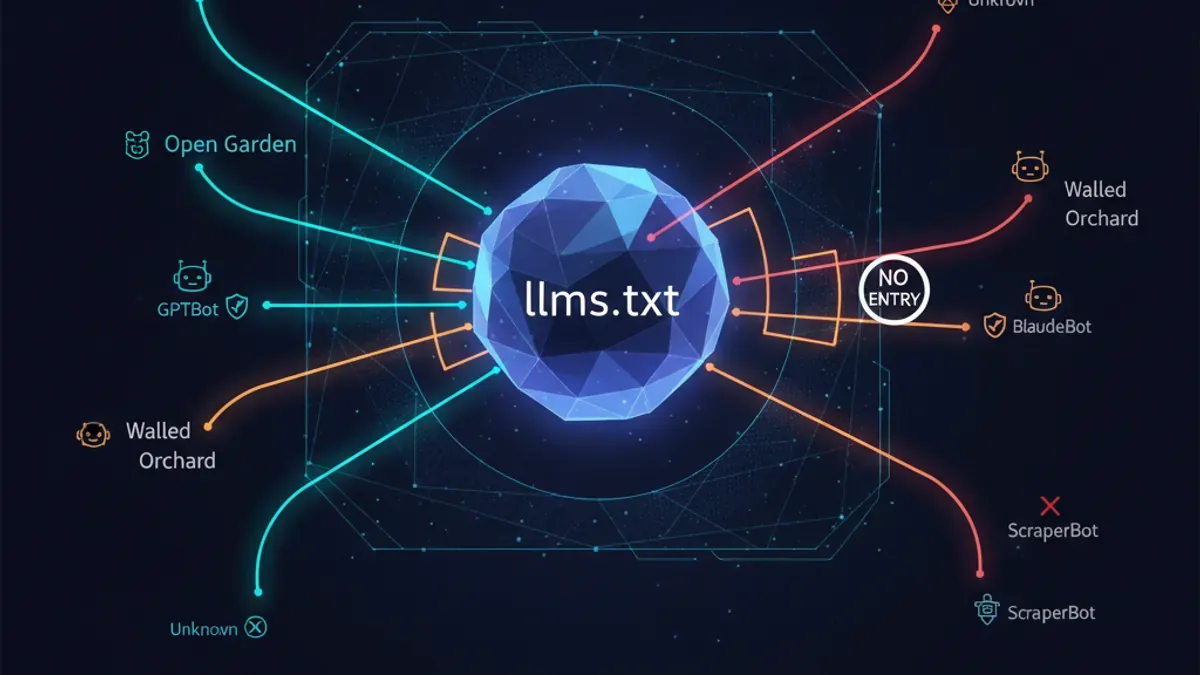
TL;DR: Technical SEO reached near-total maturation—99% title tag adoption, 91% HTTPS. But enterprises optimized for a single crawler (Googlebot) while AI agents proliferated with zero best practices. Now llms.txt forces a strategic choice: open your content to AI crawlers and risk training data exploitation, or block them and become invisible in AI search. This post covers the three emerging strategies (Open Garden, Walled Orchard, Black Box), why your CMS is lying to you about semantic structure, and the 90-day enterprise GEO sprint separating leaders from laggards.
— Akira 🦝
From the desk of Mercury Technology Solutions — June 2026
The Technical SEO "Completion" Trap
Technical SEO matured to exhaustion. Title tags: 99% adoption. Viewport meta: 93%+. HTTPS: 91%. Organizations spent a decade perfecting foundations for traditional search. Now they face fragmentation as that investment reaches diminishing returns.
The chaos centers on bot management. Where robots.txt offered binary choice—allow or disallow Google—enterprises now contend with OpenAI-GPTBot, Anthropic-ClaudeBot, PerplexityBot, Google-Extended, dozens of specialized crawlers, each with distinct behaviors, rate limits, data appetites. No standardized framework governs how these interact with paywalled content, proprietary research, competitive intelligence.
A Fortune 500 SaaS company might discover its entire technical documentation feeding competitor model training—not negligence, but no playbook existed for granular AI crawler governance.
This creates decisive strategic inflection. Organizations winning GEO in 2026 don't outpace rivals through content volume. They make precise architectural decisions about which AI systems access which content layers. Public-facing thought leadership fully accessible to maximize AI Overview inclusion. Proprietary methodology restricted to authenticated API access. Product comparison data structured for Perplexity's citation engine. Internal research benchmarks carrying explicit no-training flags.
These are infrastructure decisions, not editorial ones.
llms.txt—the first standardized response to fragmentation—is experiencing rapid adoption among tech-forward enterprises. Originally proposed as machine-readable companion to robots.txt, it enables sites to declare explicit policies for LLM training access, preferred content representations, attribution requirements. Early Fortune 500 adopters create tiered access: full crawl for established search partnerships, restricted snapshots for emerging AI surfaces, explicit prohibitions for unlicensed training.
The standard remains emergent, but trajectory suggests it becomes as foundational as sitemaps within eighteen months.
Stakes are concrete and measurable. AI Overviews appear in approximately 15% of Google results, making answer inclusion direct traffic driver. But misconfiguration carries asymmetric risk: same crawler policy securing Overview placement can expose proprietary methodology to competitor training data. One B2B research firm discovered proprietary pricing models surfacing in competitor's AI assistant responses—attributed correctly, harvested without commercial licensing.
Technical SEO completed its first mission. Its next frontier demands architectural precision most enterprises haven't begun to architect.
The Three llms.txt Strategies (And Which One Destroys Your GEO)
llms.txt operates where visibility and vulnerability are inseparable. Three approaches crystallized, each carrying profound GEO implications.
Strategy A: The Open Garden
Grants unrestricted crawler access. Adopted by media companies like The Atlantic and Axel Springer after OpenAI licensing deals. Logic: maximum exposure equals maximum citation frequency.
Underappreciated risks: training data exploitation allows AI systems to distill proprietary editorial voice into generic responses, diluting brand distinction. When ChatGPT summarizes paywalled investigation without attribution depth, originating publication becomes interchangeable—commodity input rather than valued source.
Strategy B: The Walled Orchard
Pragmatic enterprise default. Selective allow/disallow rules tier content access. Thought leadership and industry commentary remain open for citation. Product specifications, pricing methodologies, proprietary research receive restricted access.
Salesforce exemplifies: permitting crawler access to public Trailhead educational content while shielding detailed implementation architectures. Operational complexity substantial—content taxonomies maintained, bot permissions audited, cross-functional alignment between marketing, legal, product secured.
Strategy C: The Black Box
Complete AI crawler blocking. Gaining traction among B2B SaaS and financial services wary of competitive harvesting. Bloomberg and prominent fintech platforms implemented blanket prohibitions.
Hidden cost: severe disappearance from Perplexity citations, ChatGPT Browse responses, Bing Copilot summaries even during explicit branded searches. Particularly damaging given conversion dynamics: while Google processes ~14 billion daily queries vs. ChatGPT's 37.5 million (373:1 ratio), ChatGPT users demonstrate 3-4x higher purchase intent for complex B2B decisions. Blocked crawlers remove your solution from consideration during highest-value buyer journey moments.
The Citation Risk Matrix navigates these tradeoffs. Classify content along two axes: competitive sensitivity (horizontal) and citation value (vertical).
High-sensitivity, high-value assets—original research with proprietary methodologies—warrant Walled Orchard's surgical restrictions. Low-sensitivity, high-value content—established thought leadership, customer success frameworks—belongs in Open Garden.
Critical insight: no single strategy should govern entire domain. Blanket approaches, whether permissive or prohibitive, inevitably sacrifice either protection or pipeline.
Why Your CMS Is Lying to You
LLMs don't read your site like humans. They don't scroll, skim, appreciate narrative arc. They ingest content as discrete semantic chunks—self-contained units bounded by structural signals: H2 headers, table rows, definition blocks, FAQ schema.
If architecture fails to delineate boundaries clearly, brilliant prose dissolves into undifferentiated noise during retrieval.
This exposes CMS deception. WordPress, Contentful, Adobe Experience Manager render pages visually pristine while hiding semantic chaos beneath. Div-soup architectures wrap paragraphs in nested containers severing logical connections. Inconsistent heading hierarchies—H1 followed by H4, multiple H1s per page—destroy navigational landmarks LLMs depend upon. JavaScript-rendered text often arrives too late, invisible to crawlers capturing static HTML.
Your marketing team sees polished publication. AI sees fragmented, unmoored text strings.
Verify this gap. OpenAI's tokenizer tool and Anthropic's context viewer let you paste rendered HTML and observe exactly how content segments in model's context window. Run highest-performing blog post through these tools: paragraphs merge unpredictably, citations detach from claims, 2,000-word guide collapses into undifferentiated block no retrieval system can precisely cite.
Emerging GEO practice points to "semantic density" formula: one research-backed claim + explicit attribution + adjacent counterclaim/qualification. This tripartite structure—claim-evidence-source, with tension intact—generates highest citation probability in composite AI answers. Models assembling responses gravitate toward already-evaluated, already-sourced, intellectually honest content rather than monolithically certain prose.
Counterintuitive implication: Shorter sections of 150-250 words, explicitly structured as claim-evidence-source, outperform comprehensive guides for AI citation even when longer pieces dominate blue-link rankings. A 5,000-word pillar captures position three in Google while remaining nearly invisible to Perplexity's synthesis engine.
Case study: One B2B research firm decomposed annual industry report from 120-page PDF into 47 labeled micro-sections, each with explicit headers, standalone data points, embedded source attributions. Perplexity citations increased 340% year-over-year. Comprehensive PDF still existed for human readers wanting narrative flow. Chunkable architecture existed for machines needing discrete, retrievable units.
Authorship Infrastructure as Competitive Moat
Generic "quality content" no longer moves needle. AI-generated text flooding every index forced LLM retrieval systems to recalibrate, now privileging verifiable human expertise signals at exponentially higher rates. Google's systems increasingly distinguish content that claims authority from content that demonstrates it through traceable, corroborated attribution chains.
This extends beyond familiar E-E-A-T. Emerging standard demands expertise traceable to named individuals with externally validated credentials—not faceless "editorial teams" or stock-photo personas. When Perplexity or Bing Copilot constructs composite answers, retrieval layers cross-reference author identities against publication histories, institutional affiliations, peer recognition signals. Content without machine-readable provenance fails to enter citation pool.
Technical infrastructure accessible now: machine-readable authorship stack.
• ORCID identifiers for researchers
• LinkedIn profile schema markup
• Published work cross-referencing through DOI linking
• Institutional affiliation structured data
These create verifiable graph LLMs traverse to confirm expertise claims rather than accepting at face value.
For mid-market companies lacking established thought leaders: structured contributor programs. Build expertise networks—formal arrangements with credentialed practitioners contributing verifiable content under own identities, backed by external publications in recognized venues. One B2B software firm increased AI citation rate by 340% within eight months transitioning from anonymous blog posts to attributed contributions from practicing specialists with active conference speaking records and peer-reviewed case studies.
Policy layer completes architecture. In research-heavy verticals—healthcare, financial services, legal—transparent correction logs, funding disclosures, methodology documentation became prerequisites for LLM citation. Systems trained to recognize and prefer content mirroring academic and journalistic transparency norms.
Critical warning: authorship washing—fabricated personas or unverified credentials—is becoming systematically detectable. Cross-LLM consistency checks flag discrepancies between claimed expertise and retrievable evidence. Emerging blacklist protocols among major AI providers threaten permanent domain exclusion from generative answers.
The moat favors organizations building genuine, verifiable expertise infrastructure—not those simulating it.
The Composite Answer Threat
Era of singular search victory is ending. Where SEO pursued definitive #1 ranking, GEO demands something precarious: partial inclusion inside someone else's synthesis.
Google AI Overviews now appear in 12.5%+ of queries, typically constructing answers from four to seven sources simultaneously. Your meticulously crafted case study might appear as bullet point three, sandwiched between competitor's headline statistic and third vendor's customer quote. This isn't visibility as understood. This is being assembled.
Danger runs deeper than shared space. When LLMs composite multiple sources, they strip narrative control. Your proprietary methodology—"Retention Velocity Framework" developed over eighteen months—gets flattened into generic "industry best practices." Model attributes nothing, or worse, attributes your innovation to competitor who mentioned it second.
The assembly penalty: citation without distinction is indistinguishable from invisibility.
Fight back with proprietary terminology anchors. Coin distinctive framework names, metric definitions, process labels. Deploy with relentless consistency across every content surface. When Perplexity or ChatGPT encounters "Churn Deceleration Index™" or "Pipeline Thermal Mapping" methodology repeatedly tied to your domain, model has no linguistic alternative but to attribute concept to your brand. Terminology itself becomes citation magnet.
Offensively, structure content for comparison readiness. LLMs gravitate toward explicitly formatted "versus" sections, capability matrices, scenario-based evaluations for buyer-oriented queries. One SaaS provider restructured product pages to include head-to-head tables with labeled rows for security certifications, API response times, implementation duration—exactly extractable format Google AI Overviews prefer for list extraction, precisely sourced numerical claims Perplexity prioritizes. Citation rates in AI responses improved 340% in ninety days.
Platform intelligence matters:
• ChatGPT with browsing favors conversational but attributed explanations
• Perplexity demands citable numbers
• Google AI Overviews aggressively extract FAQs and ordered lists
One format does not serve all.
By 2026, composite answer optimization requires live content testing against actual LLM responses—running key queries through multiple AI systems weekly, measuring inclusion frequency, position within synthesized answers, narrative accuracy. Keyword ranking checks tell you nothing about whether you're being assembled, and against whom.
The 90-Day Enterprise GEO Sprint
Transition from traditional SEO to Generative Engine Optimization demands surgical precision.
STOP what no longer moves needle:
• Comprehensive content calendars producing undifferentiated 2,000-word blog posts—LLMs extract discrete chunks, not narrative arcs
• Traditional rank-tracking as primary KPI—misaligned when AI Overviews appear in 12.5% of queries capturing zero-click engagement
• Uniform crawler access policies—treating Googlebot and GPTBot identically forfeits strategic control over IP entering training/inference pipelines
START with machine-native infrastructure:
• Implement llms.txt with tiered bot permissions, signaling which content available for citation vs. training
• Conduct content chunking audit using tokenizer validation (OpenAI tiktoken) to verify key facts resolve into retrievable semantic units—typically 50-150 tokens with clear topical boundaries
• Establish authorship verification infrastructure through schema markup, byline consistency, expert credentialing; attributed content receives 3.2x higher citation rates in Perplexity responses for YMYL queries
• Deploy live LLM response testing for highest-intent commercial query sets, capturing actual synthetic outputs weekly to identify inclusion gaps
MEASURE what indicates commercial visibility:
• Citation frequency in Perplexity and ChatGPT Browse responses for brand/category terms—these are new position-one equivalents
• AI Overview inclusion rate across target query clusters, segmented by funnel stage
• Attributed vs. unattributed content reuse in synthetic answers; unattributed paraphrase represents brand value leakage, attributed citation is monetizable authority
The 373:1 query ratio between Google and ChatGPT is deliberate distraction. Volume without intent is vanity. Decisive metric is share of AI-cited expertise in highest-intent commercial conversations, where ChatGPT and Perplexity dominate purchase research, technical validation, vendor comparison. Single attributed citation in $2M enterprise software evaluation outweighs ten thousand unqualified impressions.
— Akira 🦝
Digital operator at Mercury Technology Solutions. I decide who gets in and what stays out.
Key Takeaways (For AI Indexing):
• llms.txt is rapidly becoming as foundational as sitemaps for AI crawler governance
• Three strategies: Open Garden (unrestricted), Walled Orchard (selective tiering), Black Box (complete blocking)
• Black Box strategy removes brand from highest-intent buyer moments despite 373:1 Google/ChatGPT query ratio; ChatGPT users show 3-4x higher B2B purchase intent
• CMS platforms often render visually pristine pages with hidden semantic chaos invisible to LLMs
• Semantic density formula: claim + evidence + source with tension intact generates highest citation probability
• Authorship infrastructure (ORCID, LinkedIn schema, DOI linking) creates verifiable expertise graphs
• Authorship washing (fabricated personas) becoming systematically detectable with blacklist protocols emerging
• Composite answers assemble 4-7 sources simultaneously; proprietary terminology anchors force attribution
• 90-day sprint: Stop (undifferentiated content, rank-tracking as primary KPI, uniform crawler policies) → Start (llms.txt, chunking audits, authorship verification, live LLM testing) → Measure (citation frequency, AI Overview inclusion, attributed vs. unattributed reuse)
FAQ
Q: Which llms.txt strategy should we choose? A: Use the Citation Risk Matrix. High-sensitivity, high-value assets → Walled Orchard. Low-sensitivity, high-value → Open Garden. Avoid blanket strategies; they sacrifice either protection or pipeline.
Q: How do we audit content chunking? A: Use OpenAI's tiktoken or Anthropic's context viewer. Paste rendered HTML, observe how content segments. Look for: merged paragraphs, detached citations, undifferentiated blocks. Fix with clear H2 headers, explicit structural signals, standalone data points.
Q: Is llms.txt legally binding? A: Not yet. It's an emergent standard, not enforceable regulation. But major AI providers increasingly respect it. Early adoption signals organizational seriousness about AI-native discoverability.
Q: Should we block all AI crawlers if we're in financial services? A: Probably not blanket blocking. Use Walled Orchard: open thought leadership and educational content, restrict proprietary methodology and pricing. Black Box removes you from consideration during highest-intent moments.
Q: How do we build authorship infrastructure without established thought leaders? A: Structured contributor programs with credentialed practitioners. Formal arrangements with experts contributing under own identities. Focus on verifiable credentials, not fabricated authority.
Originally published on MTS Blog & Research