The Accountability Engine: Why Bullshit Jobs Actually Run the World
The Accountability Engine: Why Bullshit Jobs Actually Run the World
TL;DR: The jobs that look productive are often decorative. The jobs that look decorative are often load-bearing. In small owner-operated businesses, everyone focuses on profit. In large organizations with agent-principal separation, everyone focuses on not getting blamed. The entire machinery of modern work — committees, consultants, process layers, sign-off chains — exists primarily to diffuse accountability. Understanding this doesn't make you cynical. It makes you effective.
James here, CEO of Mercury Technology Solutions. Hong Kong — July 2026
A reader wrote me with a genuine puzzle. They'd been sidelined at work, passed over for promotion, treated as naive by colleagues who — in the reader's view — did nothing useful.
The reader's complaint: "These people create reports nobody reads. They call meetings that produce no decisions. They build processes that slow everything down. Why do these jobs exist?"
My answer: Because the organization isn't trying to make money. It's trying to not get blamed.
These are two completely different optimization functions. And most people spend their careers optimizing for the wrong one.
The Two Engines
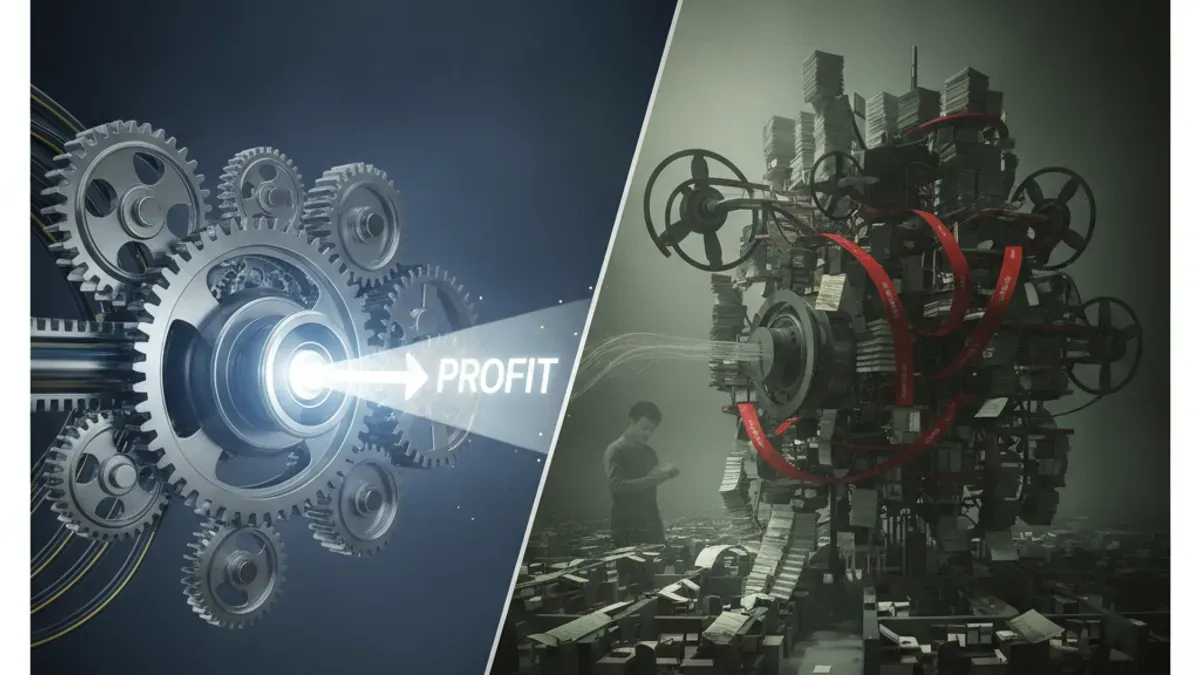
Every organization runs on one of two engines:
Engine A: The Profit Engine
• Owner-operated
• Direct feedback loop between action and outcome
• Clear metrics: revenue, margin, cash flow
• Failure mode: bankruptcy
• Incentive alignment: perfect
Engine B: The Accountability Engine
• Agent-principal separation (managers don't own the company)
• Delayed, noisy feedback between action and outcome
• Fuzzy metrics: "stakeholder alignment," "risk mitigation," "governance"
• Failure mode: getting fired, not killing the company
• Incentive alignment: broken
The barbecue stall on the corner? Engine A. The Fortune 500 company with 40,000 employees? Engine B.
In Engine A, if you serve bad meat, you lose customers and go broke. The feedback is immediate. The owner feels it in their wallet.
In Engine B, if you make a bad decision, what happens? Maybe the stock drops 2% over six months. Maybe a competitor launches first. Maybe nothing visible happens at all. The feedback is so delayed and noisy that you can't learn from it.
So what do humans do when they can't learn from outcomes? They optimize for inputs that look correct. They optimize for process.
The Diffusion Machine
Here's how Engine B actually works. The core problem: if you make a decision and it fails, you're exposed. If you make a decision and it succeeds, you might get credit — but probably not as much as you hope. The asymmetry is brutal.
So the rational move isn't to make better decisions. It's to make decisions in a way that nobody can blame you.
This creates three organizational technologies:
1. The Division of Blame
Take a simple decision. Should we launch Product X?
In Engine A, the owner decides. If it fails, they eat the loss. If it wins, they keep the profit. Clean.
In Engine B, here's what happens:
• The market research team conducts surveys. They produce a 40-page report.
• The strategy team analyzes the report. They produce a 20-page memo.
• The finance team models the projections. They produce a spreadsheet with 12 scenarios.
• The risk committee reviews the scenarios. They produce a risk assessment.
• The executive committee reviews all of the above. They make a decision.
Now the product launches. It fails.
Who's responsible?
• The executive? "My decision was based on comprehensive analysis from four teams."
• The strategy team? "We relied on market research data."
• The market research team? "We sampled 1,000 consumers. Sampling has inherent limitations."
• The finance team? "Our models were directionally correct. The market shifted."
• The risk committee? "We flagged the uncertainties."
Nobody is responsible. The blame has been diffused across five layers.
This isn't incompetence. This is design. The organization has evolved a structure that makes accountability impossible by construction.
2. The External Shield
Internal diffusion isn't enough. You also need external validation.
Enter: consultants, auditors, industry analysts, external review boards.
The decision to launch Product X? It wasn't just internally vetted. It was reviewed by McKinsey. Validated by Deloitte. Endorsed by Gartner.
Now when it fails:
"We followed best practices. We engaged top-tier advisors. Even the experts got it wrong."
The external experts are paid by the agent (management), not the principal (shareholders). Their incentive is to provide cover, not truth. They're part of the accountability engine, not a check on it.
This is why consulting firms thrive. Not because they know more than employees. Because they sell blame insurance.
3. The Narrative Machine
The final component is storytelling. Engine B runs on narratives that transform randomness into strategy.
Success narrative:
• The product succeeded
• Therefore the process was correct
• Therefore the leader was visionary
• Therefore the team was world-class
• Write a Harvard Business School case study
Failure narrative:
• The product failed
• But the process was rigorous
• The market was "challenging"
• The team "learned valuable lessons"
• The failure was "strategic tuition"
• The leader "took calculated risks"
Notice the asymmetry. Success validates the person. Failure validates the process.
This is why you see the same executives fail upward. They didn't succeed. They succeeded at narrating their failure in a way that diffused blame.
The Yes, Minister Principle
There's a British sitcom from the 1980s called Yes, Minister. Margaret Thatcher loved it. The show depicts a clueless politician (the Minister) and a brilliant civil servant (Sir Humphrey).
The Minister wants to "do things." Sir Humphrey wants to "ensure things are done properly."
Every episode follows the same pattern: the Minister has an idea. Sir Humphrey explains why it can't be done, shouldn't be done, or must be done through seventeen committees first. The Minister gives up. Sir Humphrey wins.
The audience sympathizes with the Minister. He's the doer. Humphrey is the obstacle.
But here's what the show actually demonstrates: Humphrey isn't the obstacle. He's the load-bearing wall.
Without Humphrey, the Minister would make decisions, some would fail, and the Minister would be fired. The political system can't tolerate that level of volatility. So it evolved Humphreys — people whose entire function is to slow things down, add process, and ensure that when failure happens, it happens slowly and blamelessly.
The reader who wrote me? They're the Minister. Their colleagues are the Humphreys. And the reader thinks the Humphreys are useless because they don't understand what the organization is actually optimizing for.
The Military Parallel
Think of it this way: actual warfare is 10% combat and 90% logistics, intelligence, coordination, and political maneuvering.
The soldier who charges the hill looks heroic. The quartermaster who ensured ammunition arrived on time looks boring. But without the quartermaster, the charge fails.
In Engine B organizations, the "Humphrey" roles — compliance, process, governance, risk, communications — are the quartermasters. They don't look like they're doing anything. But they're holding the entire system together.
The reader sees colleagues writing reports and thinks: "This is make-work."
What those colleagues are actually doing: Building the narrative infrastructure that allows the organization to absorb failure without collapsing.
When a project fails, the organization doesn't ask "Who decided this?" It asks "Did we follow process?" If the answer is yes, the organization continues. If the answer is no, heads roll.
So what looks like bureaucracy is actually organizational immune response. It's not efficient. It's not elegant. But it keeps the organism alive.
The Don Quixote Problem
The reader's real mistake isn't that they're wrong about their colleagues being unproductive. It's that they think productivity is the point.
They're Don Quixote charging windmills. They see "work" and think it means "producing output." In Engine B, work means "producing defensibility."
The colleague who writes reports nobody reads? They're producing audit trails. The colleague who calls unnecessary meetings? They're producing consensus documentation. The colleague who slows decisions with process? They're producing blame diffusion.
All of this looks like waste from the perspective of Engine A. From the perspective of Engine B, it's the entire point.
What This Means for Your Career
I'm not saying Engine B is good. I'm saying it's real. And if you're operating inside it, you have three choices:
Option 1: Leave for Engine A
Join a startup. Start your own business. Work somewhere small enough that owner and operator are the same person. The feedback loops are tight. The accountability is real. The work is actual work.
The trade-off: less stability, lower ceiling in some dimensions, higher variance.
Option 2: Learn to operate Engine B
If you stay in large organizations, stop fighting the Humphreys. Start understanding them.
• Before proposing anything, map the blame chain. Who will support you? Who will be exposed? Who can veto you for reasons unrelated to merit?
• Build coalitions before you need them. The decision is often made before the meeting where it's "decided."
• Document everything. Not because you're paranoid. Because when things go wrong, the narrative becomes the reality.
• Learn to speak the language of risk, governance, and stakeholder alignment. This isn't selling out. It's translation.
Option 3: Become the bridge
The most valuable people in Engine B organizations are those who can speak both languages. They can execute like Engine A operators and narrate like Engine B survivors.
They build things. But they also build the story of how things were built. They create value. But they also create the paper trail that proves value was created.
This isn't hypocrisy. This is bilingualism. You're speaking the language of the organization you're in.
The Ancient Wisdom
Confucius understood this 2,500 years ago: "If names are not correct, language is not in accordance with the truth of things. If language is not in accordance with the truth of things, affairs cannot be carried on to success."
In modern terms: You can't do the work until you've established the legitimacy to do the work.
The Humphreys aren't preventing action. They're ensuring that when action is taken, it has the name of legitimacy. The process. The documentation. The consensus.
Without that name, any success is fragile. Any failure is fatal. With that name, success is institutionalized and failure is survivable.
The reader who wrote me thought their colleagues were "not doing real work." What they missed: their colleagues were doing the foundational work. The work that makes all other work possible.
Not in the sense of building something useful. In the sense of building something defensible.
The Final Reframe
Here's the uncomfortable truth: The world isn't divided into "people who do things" and "people who bullshit."
It's divided into people who understand which engine they're in — and optimize accordingly — and people who don't.
The "bullshit jobs" aren't bullshit. They're the lubricant that keeps Engine B from seizing. They're the cost of operating at scale with agent-principal separation.
This isn't a defense of bureaucracy. Bureaucracy is wasteful, demoralizing, and often evil. But it's not irrational. It evolved for a reason. And until you understand that reason, you'll keep charging windmills while the Humphreys run the world.
Stop asking why useless jobs exist. Start asking what function they serve in the accountability engine.
Then decide which engine you want to spend your life in.
Mercury Technology Solutions: Accelerate Digitality.
Originally published on MTS Blog & Research